
Choosing the right amount of warehouse space can feel like guesswork.
Too little space creates delays, damaged stock and stressful dispatch days. Too much space means you pay for empty pallet positions you do not use.
The right answer depends on more than your current stock level. You need to consider seasonal demand, growth plans, product type, order volumes and how quickly stock moves through your operation.
At TASS Enterprise in Hertford, we support businesses starting with just four pallet spaces and growing to 157 or more. We provide managed storage, fulfilment and distribution for customers across Hertford, London, Enfield and surrounding areas.
Here is how to work out what you really need.
Start with your peak stock level
Your storage requirement should not be based on an average month.
It should be based on your highest expected inventory level.
Ask yourself:
- How many pallets do you hold now?
- What is your busiest stock period?
- How much safety stock do you need?
- Are you launching new products?
- Will sales increase over the next 6–12 months?
- Do you need space for returns, damaged goods or promotional stock?
For example, an e-commerce business might hold:
- 20 pallets during a normal month
- 30 pallets before Christmas
- 5 pallets of safety stock
- 10 pallets to support planned growth
That business should plan for at least 45 pallet spaces, rather than booking storage for only 20.
A useful starting formula is:
Required pallet spaces = current peak stock + safety stock + seasonal stock + growth allowance
You should then add a small operating buffer. Running a warehouse at 100% capacity leaves no room for receiving new goods, separating returns or changing your product mix.
A buffer of 10–20% is a sensible starting point. Your final requirement depends on your stock profile and warehouse layout.
What does one pallet space actually mean?
A pallet space is a designated position for one pallet. It is not the same as one square metre of floor space.
A common UK pallet measures approximately 1.2 metres by 1 metre, giving it a footprint of around 1.2 square metres. However, a warehouse also needs room for:
- Aisles
- Forklift movements
- Goods-in checks
- Picking and packing
- Dispatch preparation
- Returns handling
- Fire exits and safe walkways
- Temporary staging areas
This means you cannot simply multiply your pallet count by 1.2 square metres and expect an accurate warehouse size.
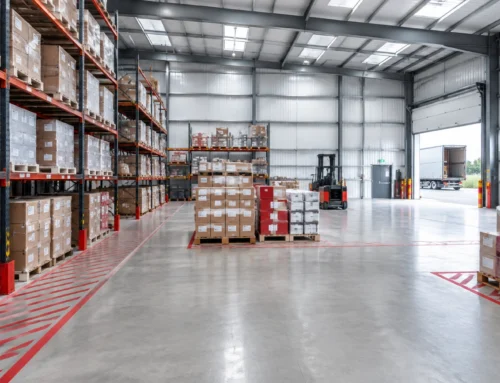
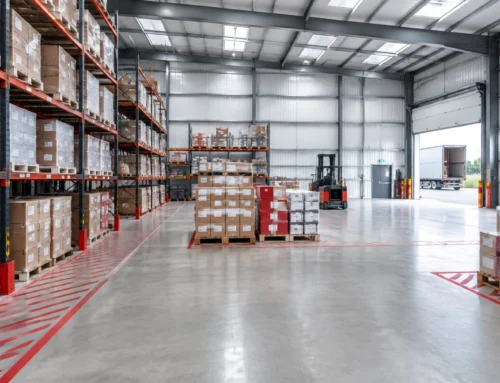
Racking height also affects capacity. A warehouse with suitable racking can store more pallets vertically than a low-level storage area. The right design depends on your products, pallet weights, handling equipment and building height.
The Red Cross warehouse guidance provides useful general principles for warehouse layout and storage planning.
A practical pallet space calculation
Let’s work through a simple example.
Imagine your Hertford or Enfield-based business currently stores:
- 60 pallets of core inventory
- 10 pallets of safety stock
- 20 pallets during seasonal peaks
- 15% planned growth
First, calculate the peak stock requirement:
60 + 10 + 20 = 90 pallets
Then add the growth allowance:
90 × 1.15 = 103.5 pallets
You cannot store half a pallet position, so round up to 104 pallet spaces.
Now add an operating buffer of 15%:
104 × 1.15 = 119.6 pallet spaces
In practice, you would plan for approximately 120 pallet spaces.
This gives you room to receive inbound deliveries, manage returns and expand without immediately needing another warehouse move.
The simple version
Use this calculation:
(Current peak pallets + safety stock + seasonal pallets) × growth allowance × operating buffer
For example:
(60 + 10 + 20) × 1.15 × 1.15 = approximately 120 pallet spaces
This is a planning estimate, not a final warehouse design. A proper review should also consider pallet dimensions, product height, SKU numbers, access requirements and daily order volumes.
Signs you have outgrown your current storage
Many businesses wait until storage becomes a serious problem before reviewing their space. Look out for these warning signs.
1. Stock is stored in walkways
If cartons and pallets are regularly placed in aisles, loading areas or around packing benches, your current space is no longer working.
This creates safety risks and slows down picking.
2. You cannot find stock quickly
A well-run warehouse should make stock easy to locate. If your team spends time searching behind other products or moving several pallets to reach one SKU, you are losing money on every order.
3. Goods-in and dispatch compete for space
Inbound deliveries should not block outgoing orders. If goods-in checks, pick and pack and dispatch all happen in the same cramped area, delays are likely.
4. You keep refusing or delaying customer orders
Running short of storage space often leads to stock being split across multiple locations. That makes inventory control harder and increases the risk of missed orders.
5. Your growth plans are on hold
If you are avoiding new products, larger supplier orders or new sales channels because you have nowhere to store the stock, your warehouse is restricting your business.
TASS Enterprise can provide managed storage alongside goods-in, pick and pack, dispatch and returns handling. We can also build custom Standard Operating Procedures around your products and order process.

Signs you are paying for space you do not need
Overestimating your storage requirement can be just as costly.
You may be paying for unnecessary space if:
- Large parts of your allocated area remain empty
- Slow-moving stock takes priority over active products
- You are storing old or discontinued inventory
- Your seasonal stock has not been reviewed after a campaign
- You are paying for a whole unit when you only need pallet positions
- Your stock levels have fallen but your storage agreement has not changed
- Your current provider cannot flex your space as your needs change
A flexible storage partner should review your requirements as your business changes.
A small online retailer may need only four pallet spaces to begin with. A growing product business may then need 20, 50 or 100 spaces. Established operations may require 157+ pallet spaces, plus fulfilment and national or international distribution.
You should not have to move providers every time your stock level changes.
Storage space is only one part of the answer
The cheapest storage option is not always the most cost-effective option.
You also need to consider what happens after your stock arrives.
Do you need your provider to:
- Check and book in deliveries?
- Store stock by SKU or batch?
- Pick individual items?
- Pack orders to your instructions?
- Apply labels or inserts?
- Process wholesale and retail orders?
- Manage customer returns?
- Distribute goods across London and the UK?
- Send international shipments?
- Handle fragile or specialist products?
These services make a major difference to your total logistics cost.
For businesses involved in logistics in retail, a reliable warehouse partner can also help you meet retailer requirements, prepare compliant deliveries and protect customer relationships.
TASS Enterprise provides complete warehouse and fulfilment support from our Hertford site. We act as an extension of your business, not simply as a place to leave your stock.
Why local storage in Hertford can work for London and Enfield businesses
Our Hertford location gives businesses across Hertfordshire and nearby areas a practical base for storage and distribution.
We support customers in:
- Hertford
- Enfield
- London
- Ware
- Hoddesdon
- Broxbourne
- Stevenage
- Welwyn Garden City
- Bishop’s Stortford
- Surrounding Hertfordshire areas
You can keep stock close to your team while accessing national and international delivery services.
This makes storage in Hertford useful for businesses that want a local partner without managing their own warehouse. It also gives London and Enfield businesses an alternative to higher-cost central storage locations.
Whether you are searching for storage units in Hertford, a managed storage solution or a complete storage facility business to run your logistics, the right provider should match space to your actual operation.
What size business can TASS Enterprise support?
TASS Enterprise works with businesses at different stages of growth.
You may be:
- An e-commerce start-up storing four pallets
- A charity holding supplies and campaign materials
- A retailer preparing stock for national distribution
- A product business managing fragile goods
- An established operation requiring 157+ pallet spaces
- A company expanding into international markets
Our services include:
- Managed storage
- Goods-in and stock checks
- Pick and pack
- Fulfilment with custom SOPs
- Dispatch and returns handling
- National distribution
- International distribution
- Support for fragile and complex products
We also offer a “We Beat Any Quote” guarantee, helping you compare the cost of outsourced logistics with your current arrangement.

How to choose your next storage step
Before requesting a quote, prepare these details:
- Your current pallet count
- Your expected peak pallet count
- Your average monthly inbound deliveries
- Your average daily or weekly orders
- Your number of SKUs
- Your product dimensions and weights
- Your busiest seasonal period
- Your preferred delivery areas
- Any special handling requirements
- Your expected growth over the next year
This gives a storage provider enough information to recommend a practical solution.
Do not focus only on the number of pallets. Focus on the whole flow of your stock, from goods-in to storage, picking, packing, dispatch and returns.
That is how you create hassle-free logistics that supports growth instead of slowing it down.
Get the right Hertford storage space for your business
You may need four pallet spaces today and 157 next year. Your storage partner should be ready for both.
TASS Enterprise provides flexible, managed storage and fulfilment from Unit 21, Merchant Drive, Mead Lane, Hertford, Hertfordshire SG13 7AY.
We support businesses across Hertford, London, Enfield and surrounding local areas with practical storage, fulfilment and distribution solutions.
Call TASS Enterprise on 01992 505 500 to discuss your current stock levels, future plans and the right amount of space for your business.
You can also explore our managed storage services, fulfilment services and distribution solutions.